LOTTA
The COP Is Cracking: The Truth That Finds No Space in Official Agendas
The COP Is Cracking: The Truth That Finds No Space in Official Agendas
After the Indigenous peoples’ breakthrough at COP30 in Belém, the distance between institutions and territories becomes undeniable
By LILLO (Lorenzo Barili), who together with LOTTA is documenting COP30 from the perspective of Indigenous peoples and the Cúpula dos Povos
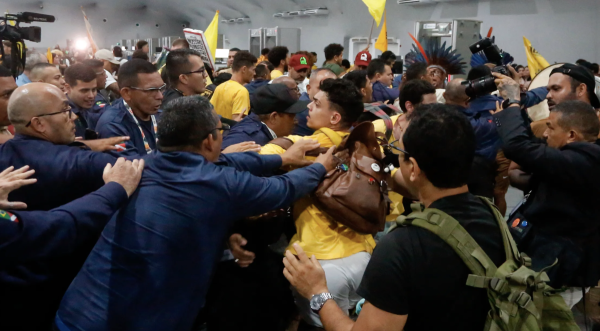
Belém, 14 November 2025 | “It is a moment of revolt, of indignation. It is the moment in which we Indigenous peoples feel the defeat of our territory on our skin,” said activist Cacique Gilson after last night’s breakthrough into the main pavilion of COP30 in Belém. The Guardian
Hundreds of people — Indigenous and non-Indigenous — crossed the conference entrances, shouting and waving banners until UN security forced them out, at least according to some media reports.
Although I believe they stayed until 8 in the morning and then left voluntarily. This is what I learned from someone I spoke to in Portuguese and from Loica’s stories.
Two officers were slightly injured; outside, firefighters formed a cordon to block access.
An episode that comes just hours after the barqueata of local movements and marks a disruptive, symbolic moment for this year’s COP.
I am writing from Belém, where it’s clear that this is not just a climate conference: it is a political laboratory, where the language of diplomacy collides with the lived reality of the territories and the peoples most affected by the climate crisis.
I arrived in Belém to understand what hope remains for us as humanity in the face of an unprecedented emergency. And here the conflict is more visible than ever: the future of the climate will not be decided only through regulatory mechanisms and carbon markets, but — more deeply — through our ability to remain united as humans and as peoples, overcoming the history of division, individualism, and exploitation that keeps us chained.
Last night’s breakthrough is not an accident; it is a crack that reveals what diplomacy tries to cover.
What we call disorder is, in reality, the form truth takes when it no longer finds space in official agendas.
It is not violence — it is a symptom. It is the collective body reacting to the institutional hypocrisy of those who speak of climate justice while continuing to finance deforestation, war, and extraction.
Outside the pavilions, along the Guamá River, the city fills with marches, music, songs, and flags.
In Belém, one breathes a tension that is not anger but clarity.
The peoples who live closest to the land know that the problem is not the climate but our idea of economy.
Climate justice will not be born from an algorithm or a green fund, but from the recognition of limits: the limits of the planet, and the limits of human greed.
Brazilian authorities had announced this as “the most participatory COP ever,” open to civil society and to the demands of Indigenous peoples.
But yesterday’s event took things one step further. Entering the main venue of COP30 on the very first night — without interrupting the negotiations — and then walking straight to the Cúpula dos Povos.
It is a gesture of defiance with a clear meaning:
“We are not stakeholders. We are not third parties to consult. We are the leadership.”
When the peoples enter the conference hall without being invited, it is not an invasion — it is an act of restitution.
Last night, while outside the convention center the chants of demonstrators continued, I thought that perhaps the real transition will not be only energetic, but cultural and political: learning to share space, words, breath — like a global, organized community.
A single people who know they have no “Planet B” to inhabit.
And as I write these lines, yesterday afternoon the Minister for Indigenous Peoples, Sonia Guajajara, organized another march inside the COP, as seen on her Instagram account.
As Lotta wrote in her contribution yesterday:
“It was a lesson in freedom. Célia Xakriabá speaks of struggle, but she does so with the grace of someone who knows the lightness of the deepest truths: to go far, you don’t need to strike — you need to know how to fly.
To be arrows, yes, but arrows that dance.
Arrows that reach the heart not to wound, but to awaken.
Arrows that cross the air with irony and joy, as music, dance, and poetry can.
And I believe this is the greatest lesson of all: art serves to reveal truth without violating it, to bring into the present what ancient cultures had already understood — that the world is not to be possessed, but to be cared for.
If we had listened to those cultures instead of erasing them, perhaps today we would not have a climate crisis to solve.” (iPressLIVE)
Keep following us as we continue to tell the story of COP30 through the eyes of these “lenses that will never be transparent again.”
Lorenzo Barili (LILLO)
Caricato il 13/11/2025
Organizzazione

 LA COP DEI POPOLI | LOTTA alla COP30 con LILLO (Lorenzo Barili)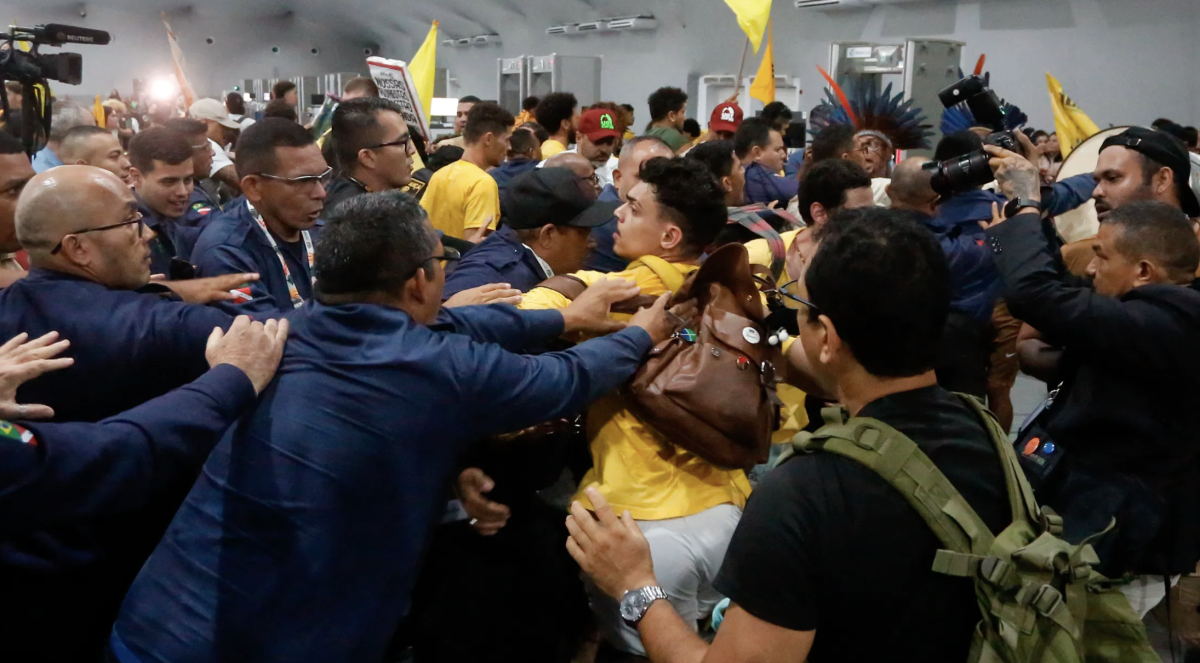
Settori
- Economia circolare / Sviluppo Sostenibile
- Musica
- Politica estera
- Primo piano Politica estera
- Sostenibilità